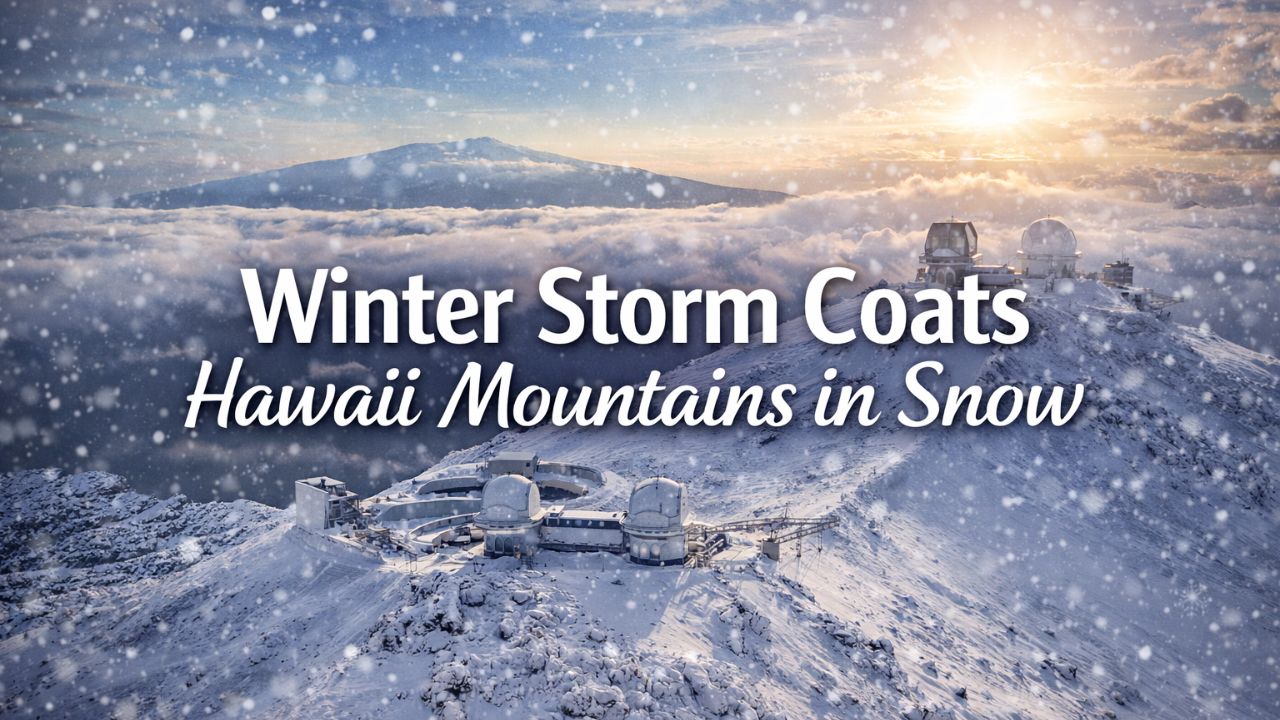
Honolulu, Hawaii — A powerful winter storm delivered an unusual sight across the Hawaiian Islands this week, coating the state’s highest mountain peaks in several inches of snow as a cold-weather system pushed through the region.
Snowfall accumulated across the summits of Mauna Kea and Mauna Loa, where 8 to 10 inches of snow were reported by early Monday, according to weather officials. While snow in Hawaii often surprises those unfamiliar with the islands’ geography, meteorologists say the event itself is not unprecedented — though its timing and impacts have drawn attention.
Snow blankets Hawaii’s highest peaks
Video footage shared from the summit of Mauna Kea showed the normally rocky terrain completely covered in white, with observatories and access roads buried under fresh snow. The footage was filmed by a telescope operator at the W. M. Keck Observatory, offering a striking view of the winter conditions.
“The summit was entirely snow-covered, with continued snowfall through the advisory period,” officials said, noting reduced visibility and hazardous travel conditions at higher elevations.
Webcams positioned near the summits continued to show snow lingering into Tuesday, as colder air remained trapped over the island’s tallest peaks.
Winter Weather Advisory remains in effect
The National Weather Service kept a Winter Weather Advisory in place for the Big Island summits through Tuesday, warning of additional snow and a mix of frozen precipitation, including ice.
Officials cautioned that road conditions near the summits could remain dangerous, particularly due to slick surfaces, gusty winds, and rapidly changing visibility.
“Even small additional snowfall amounts can significantly impact travel and operations at these elevations,” forecasters noted.
Part of a larger Kona low system
The snow event is part of a broader Kona low weather system affecting Hawaii this week. Kona lows are slow-moving, cold-core storms that can bring heavy rain, strong winds, thunderstorms, and winter conditions to the islands.
While snow fell at the highest elevations, lower elevations across the Big Island experienced flooding, water rescues, and strong winds, according to local emergency officials. High Surf Advisories were also issued for eastern-facing shorelines, with rough ocean conditions expected to persist until the system weakens.
Meteorologists expect the Kona low to gradually break down by midweek, allowing conditions across the state to improve.
Snow in Hawaii: rare, but not unusual
Despite its tropical reputation, Hawaii regularly experiences snow at its highest elevations due to the extreme height of Mauna Kea and Mauna Loa, both of which rise above 13,000 feet — higher than the tallest peaks in 44 U.S. states.
Because of their elevation, these mountains routinely see snow during fall, winter, and spring, particularly when cold upper-level systems pass through the central Pacific.
Unlike many mainland states, Hawaii does not officially measure snowfall totals. However, historical data shows that 25 to 30 winter weather advisories are typically issued for the Big Island summits each year.
Timing of winter advisories varies widely
Over the past two decades, the timing of winter weather advisories in Hawaii has ranged significantly. Records show the earliest advisory during that period was issued on October 13, 2014, while the latest occurred on June 8, 2018.
Read Also: Scattered Storms Target North Texas Midweek as Much Cooler Air Moves Into DFW This Weekend
This wide window highlights how snow events in Hawaii are driven more by atmospheric patterns than by traditional seasonal boundaries.
“Because snowfall isn’t tied to a traditional winter season here, it can occur well into spring or arrive surprisingly early in the fall,” meteorologists explain.
Looking ahead
As the Kona low weakens, forecasters expect warmer temperatures and drier conditions to return across the islands later this week. However, officials urge residents and visitors to remain cautious near summit areas, where icy conditions may persist even after snowfall ends.
Authorities continue to remind drivers and hikers that conditions at high elevations can change rapidly, and travel should be avoided during active advisories.
For many, the snow-covered Hawaiian peaks serve as a reminder of the islands’ dramatic contrasts — from tropical beaches to alpine winter conditions within just a few miles.
Did you see the snow-covered summits or experience storm impacts where you live? Share your photos, experiences, or thoughts in the comments below.